Be a shiny needle: crafting standout startup job applications
How to signal that you're a driven person who solves important problems.

We screen hundreds of applications a week for engineering & data science roles at Axle Energy. Many of these CVs are from people who don’t actually want a job at our company. In fact, most of the applications we receive give no hint that the applicant has engaged with what we do at all.
That’s understandable - it’s time consuming to apply for jobs, and there’s an arms race going on between algorithmic job applications and algorithmic CV review (which we don’t use). But if you’ve read this far, it’s possible that you are in the minority of folk who have the time & energy to submit really good job applications. If so, read on.
Your aim, as somebody who does actually want this job - this specific job - is to make it easy to identify that you’re in the minority of applicants who understand what startups look for in engineers. The question you need to answer, with a resounding yes, is: will this person help us succeed?
Your CV is not a summary of your life: it is a tool. It should be designed to solve a user’s - the hiring manager’s - problem, in a way that aligns with your interests - giving you an interview. Your CV should be like the Amazon buy-now button, effortlessly ushering me towards the action you want me to take.
This is mostly going to consist of removing things from your CV. This will also help you limit its length to 1 page, which is all you need.
What startups care about
A track record of helping companies achieve their goals
Startups succeed when they identify problems in the real world, solve them, and get paid. They want to hire people who have solved valuable problems before, in similar contexts, with relevant technologies.
This is the lens through which you should refract all of your experience. You should describe:
- what the company was doing
- what problem they needed your help with
- how you got it done
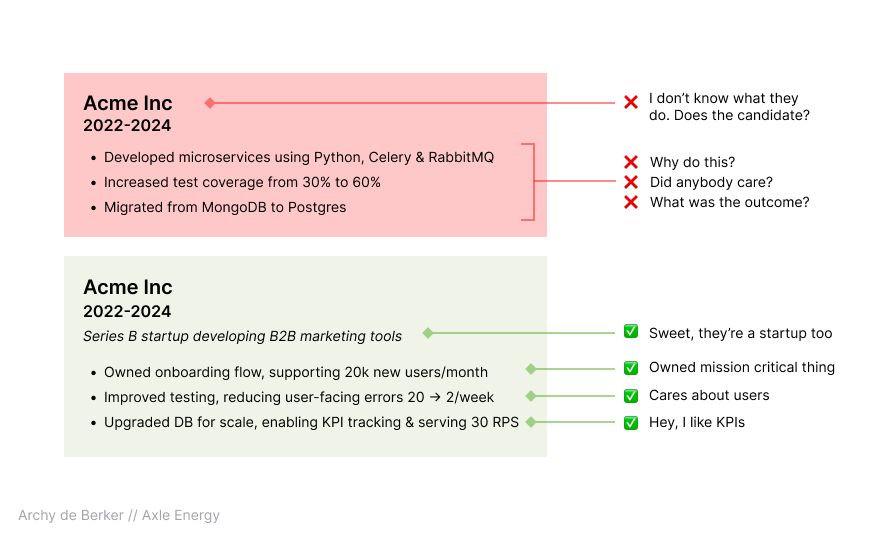
It’s great if you have numbers (£, users, transactions), but it’s fine if you don’t. Just being able to explain a few problems and how you solved them will put you in the top 10% of candidates.
Of course it’s better if you used tools that are similar to the ones that the company uses, but this isn’t important: somebody who solves real problems using Javascript can adapt to solve real problems using Python, or Go, or Rust.
Drive
Startups are tiring and require a constant injection of energy. We want to hire ambitious, driven people, who bring energy to those around them. These kinds of people often do unusual things with their free time. Maybe they don’t have much free time any more - they might be parents, or running a company, or caring for a relative - but there’s usually a hint that when they did have more free time, they utilised it.
The best thing to have on your CV is an interesting side project which somebody can interact with. Top marks if it solves a real problem (please dudes, no more weight-lifting apps 🤙), you actually got in front of a user you didn’t know, and you tried to monetise it.
There are lots of other ways to show drive. I find there’s signal in:
- Making things - writing, art, dance, music - and getting them out into the world, especially if it required some courage
- Playing sport at a high level. This typically requires dedication and discipline - the less talented you are the better.
- Taking your hobbies a bit too far. Several of our engineers have built extensions to games they love. I don’t personally enjoy gaming, but I have a lot of time for people who are in the most intense 1% of whatever they do, irrespective of content.
Don’t confuse “participating” with “demonstrating grit, excellence, or courage”. Being in a play is not necessarily impressive, but writing one is; playing in a 5-a-side league is not impressive, playing for England is; listening to the radio isn’t, building radios is. You get the idea.
A quick note on bias: men are more likely to be explicitly ambitious in the hiring process. Lots of blokes think they’re going to end up as CEOs/Founders/Philosopher-Kings. If you’re less comfortable talking about your achievements or displaying naked ambition in interviews, it’s even more important to show-not-tell in your CV.
Social proof of excellence
If you’ve been promoted at your company, you should say that. It’s reassuring to see that people who have worked with you think you’re good, and given you more responsibility.
In very rigid promotion regimes (Google, McKinsey etc.) candidates sometimes drop helpful hints of the average tenure at each level and how they were promoted ahead of schedule; this is helpful, albeit slightly obnoxious (that’s a worthwhile trade-off!).
A nice-looking CV
Spoiler: startup founders are not only picky and demanding, we’re capricious and vain.
The joy of being an engineer at a startup is that the gap between your work and the outside world is paper thin. You don’t have to wade through layers of bureaucracy & QA to ship something.
But that also means there’s probably no designer or PM who can devote hours to making your work fit for human consumption. It’s super reassuring to me as a hiring manager if somebody can put together a CV that looks good and doesn’t contain any typos. After all, I am hiring you to build things.
If you don't produce a single sheet of error-free, decent-looking A4, it raises immediate concerns about your ability to ship complex software directly into the arms of clients.
The best engineers I’ve worked with are also excellent writers. This makes them effective collaborators in async or highly scaled environments. I think the premium on this has actually gone up since Claude started vomiting out design docs.
You should never submit a Word Doc as CV, unless you enjoy seeing your professional achievements chewed up and regurgitated with random alignment and missing fonts.
That you will be enjoyable to work with
Unlike in a BigCorp, the person reading your CV is likely to work closely with you for many hours a week.
It’s helpful if you can drop a few reassuring hints that this will be tolerable, or even enjoyable. I’m personally a sucker for a sense of humour in a CV. I’m told this is not a fair thing to screen for, but I think it’s probably true for everybody screening CVs that if you can make them smile, you have a better shot.
Don’t take this to mean that you need to be some kind of social wizard. Most people working at startups are a bit intense, fairly nerdy, and more than a little addicted to what they do. Most startups are looking for people with some personality, not a specific personality.
What startups do not care about
Going to keep this punchy, since it’s a bit mean, but I think it’s helpful:
- Professional certifications of any kind. Seriously. Just get rid of these. Particularly waffly ones like “Agile Principles Qualified” or “AWS trusts me to sell AWS”. These are red rags to angry founder bulls, who started companies to get away from corporate claptrap.
- How many technologies you know. You can probably figure out which ones your target company is likely to care about. Mention those, but tie them to a problem you solved using them.
- Your ability to use MS Office. Never put this on a CV. Your ability to read, write, and feed yourself is also taken as read.
- Papers you have authored, unless you’re applying somewhere deep-techy which will apply your specific expertise. Sorry, I know you’re proud of them. This was a bitter pill for me to swallow too.
- Whether you have a driving licence.
- Irrelevant roles you have held e.g. bartender, dogsitter, lifeguard.
The cover letter
The cover letter is your additional shot on goal. The key function of the cover letter is to customise your application to the company you’re applying to.
This is online dating; your CV is your Hinge profile (a highly selective account of your most desirable attributes), and your cover letter is the first DM. Remember, founders are vain; make them feel special.
Here’s one, which speaks to our company’s mission:
I want to work on climate change, the defining challenge of our generation. I’ve done a lot of research, and Axle Energy looks like the place I can have the biggest impact on climate change in the next decade. Decarbonizing the power sector is instrumental to cleaning up the rest of the economy, and if I can play a meaningful role in that then I’ll consider my career a success. I think that together we can decarbonize the grid - looking forward to discussing.
Here’s another, which is more focused on personal growth and drive:
The amount you guys have achieved in the first 2 years is insane. I prioritize working with people I can learn from, and you’re clearly a crazy talented bunch. I’m extremely motivated to work hard and make a dent in the universe, and I think Axle is a place where I can find like-minded people to grow with, ship insane amounts of software, and build something great.
Or maybe you wanna keep it brief:
Axle is winning. I like winning. You should hire me, and we’ll win bigger - which will be great for the grid and the climate.
These are all fake, and I would interview all of them. The signal from a thoughtful, eccentric cover letter is so strong that I almost wouldn’t bother looking at the CV.
In summary
- Provide evidence that you are somebody who understands what’s important to the success of whatever you are working on, and does it. Remove content that implies otherwise.
- Emphasise things which demonstrate personal qualities that startups value, like determination, creativity, and ambition.
- Don’t be afraid to have a little fun. Express a bit of personality and make someone smile.